roman nowotarski - opinions
This is what one of the greatest Polish painters said about his creative output:“This art has always attracted me almost magnetically. How obsessive vision of the landscape stripped of people, the landscape of the workers' districts of the factory town, founded in the 19th c., sunk in the deep nostalgic colour, connected by an almost geometrically simplified drawing, is decidedly authentically personal.
Format means used by Nowotarski are of this class that this vision moves and awakes deeper reflections, probably touching the existential layer of life, this extremely poetic art".
Tadeusz Brzozowski
Format means used by Nowotarski are of this class that this vision moves and awakes deeper reflections, probably touching the existential layer of life, this extremely poetic art".
Tadeusz Brzozowski
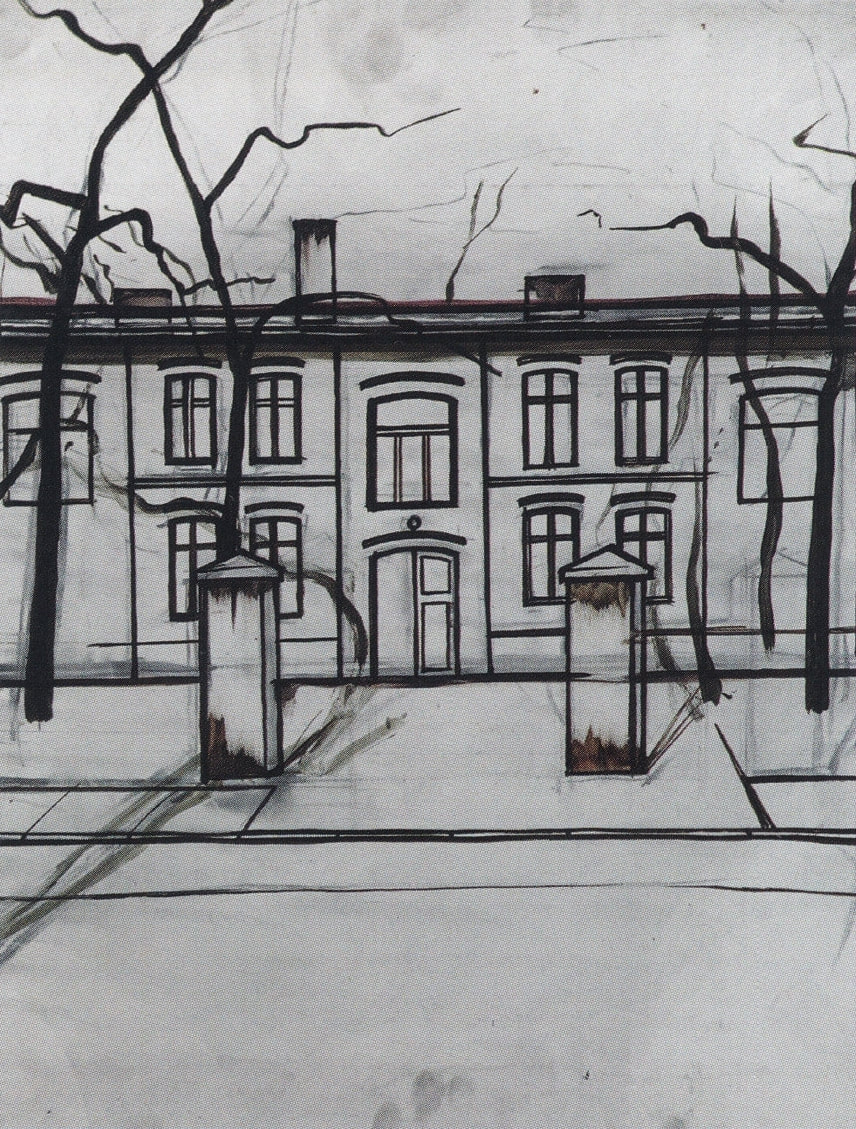
Sketch for a painting, 1970s
I cannot say that I know Roman Nowotarski 's works in their entirety as unfortunately I have not been able to see any of his theatrical or film scenography. I am persuaded as to its impact and importance as a form of his artistic expression judging by the awards he received in the period of 1967-1973. I suppose, however, that there is a traceable connection between this field of Roman Nowotarski's artistic activity and his canvas painting.
Paintings by Nowotarski are often structured on the basis of the "world theatre", an empty stage made ready for actors to come. I do not mean an apron stage, as his paintings are far from any concepts of illusionism. What joins them with the art of scenography are the problems of space and light. It can be added that these are the issues encountered by any kind of painting and that by the very nature of the work of painting art they must be solved on a plane, inscribed in its square or rectangular shape. There is no place here for literality, only for transpositions and suggestions; there is no place for movement and change, only for conservation, choice of elements and their combination into a coherent whole.
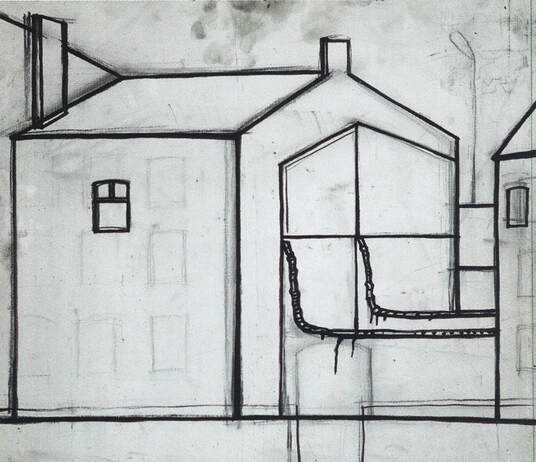
Such coherence can be achieved both by austere simplicity and by multiplied and complex richness of forms. Nowotarski chooses the sim plicity and in his choice he remains consistent. His paintings present clear divisions, large planes; he often employs directly vertical and directly horizontal lines. He therefore prefers works produced by human hands and by machines, ruled by geometry: buildings, harbours and fences - and avoids the organic profusion of nature. If one comes in his works across a tree, it is a ruthless and leafless one. Such mindless removal of ornaments and charms of nature may partly stem from the reality of cityscape in Silesia, where Nowotarski lives and works. However, it is known that artists seewhat they want to see, as their vision is selective and hence that they convey what they want to convey. I suppose then that the reality of the Silesian city scape determined the artistic vision presented to us by Nowotarski only in a limited way. Flat planes, lines of the horizon, raw planks and bare large panel dwelling blocks, sad and ugly tenement houses - all these are elements of Silesian reality, yet they are selected, simplified, monumentalised by the artist's intent. The emptiness, sadness and charmlessness of the cityscape become the core of Nowotarski's unique aesthetics. It may be defined as aesthetics of austerity, simplicity and bareness. The only "luxury" that the artist allows himself to use in his paintings is the beautiful laying of the paint, at times thin, at others thick, but never "viscid". It is subtly diversified, depending on the substance of the things represented. Yet again, this diversity cannot be identified with virtuoso illusionism; it exists as if "for itself only". Narrow colour range with scarce stronger accents har monises with the ascetic form. It results in nostalgic mood and an air of mystery, resembling the mystery emanating from paintings by De Chirico in his period of "pittura metafisica". We do not observe, here however, touches borrowed from surrealism. The relations between objects are ordinary and the things themselves deliberately common: litter bin, carpet-hanger, metal fence net, a line of train cars. The little dog, oftentimes the only living being in the lonely streets, har bours and courtyards, is but a mongrel. This little dog is a very important element in the paintings by Nowotarski; it is the "lyric subject" of these paintings, as well as a symbol of loneliness, while also a touch of warmth. Loneliness is also the state of the people, appearing very rarely and as if on the margins. Only the wedding couples are placed in the centres of the paintings, but they seem rather like sceptres evoked from old photos.
A separate description is due to posters by Nowotarski, of which unfortunately I know only two: the extremely witty "Chirp, Chirp, Chirp behind the chimney" and the one in honour of Wysocki, which I called for myself the "thorny guitar'', a beautiful artistic metaphor of the fate of the great Russian singer.
Maria Rzepinska
Paintings by Nowotarski are often structured on the basis of the "world theatre", an empty stage made ready for actors to come. I do not mean an apron stage, as his paintings are far from any concepts of illusionism. What joins them with the art of scenography are the problems of space and light. It can be added that these are the issues encountered by any kind of painting and that by the very nature of the work of painting art they must be solved on a plane, inscribed in its square or rectangular shape. There is no place here for literality, only for transpositions and suggestions; there is no place for movement and change, only for conservation, choice of elements and their combination into a coherent whole.
Such coherence can be achieved both by austere simplicity and by multiplied and complex richness of forms. Nowotarski chooses the sim plicity and in his choice he remains consistent. His paintings present clear divisions, large planes; he often employs directly vertical and directly horizontal lines. He therefore prefers works produced by human hands and by machines, ruled by geometry: buildings, harbours and fences - and avoids the organic profusion of nature. If one comes in his works across a tree, it is a ruthless and leafless one. Such mindless removal of ornaments and charms of nature may partly stem from the reality of cityscape in Silesia, where Nowotarski lives and works. However, it is known that artists seewhat they want to see, as their vision is selective and hence that they convey what they want to convey. I suppose then that the reality of the Silesian city scape determined the artistic vision presented to us by Nowotarski only in a limited way. Flat planes, lines of the horizon, raw planks and bare large panel dwelling blocks, sad and ugly tenement houses - all these are elements of Silesian reality, yet they are selected, simplified, monumentalised by the artist's intent. The emptiness, sadness and charmlessness of the cityscape become the core of Nowotarski's unique aesthetics. It may be defined as aesthetics of austerity, simplicity and bareness. The only "luxury" that the artist allows himself to use in his paintings is the beautiful laying of the paint, at times thin, at others thick, but never "viscid". It is subtly diversified, depending on the substance of the things represented. Yet again, this diversity cannot be identified with virtuoso illusionism; it exists as if "for itself only". Narrow colour range with scarce stronger accents har monises with the ascetic form. It results in nostalgic mood and an air of mystery, resembling the mystery emanating from paintings by De Chirico in his period of "pittura metafisica". We do not observe, here however, touches borrowed from surrealism. The relations between objects are ordinary and the things themselves deliberately common: litter bin, carpet-hanger, metal fence net, a line of train cars. The little dog, oftentimes the only living being in the lonely streets, har bours and courtyards, is but a mongrel. This little dog is a very important element in the paintings by Nowotarski; it is the "lyric subject" of these paintings, as well as a symbol of loneliness, while also a touch of warmth. Loneliness is also the state of the people, appearing very rarely and as if on the margins. Only the wedding couples are placed in the centres of the paintings, but they seem rather like sceptres evoked from old photos.
A separate description is due to posters by Nowotarski, of which unfortunately I know only two: the extremely witty "Chirp, Chirp, Chirp behind the chimney" and the one in honour of Wysocki, which I called for myself the "thorny guitar'', a beautiful artistic metaphor of the fate of the great Russian singer.
Maria Rzepinska
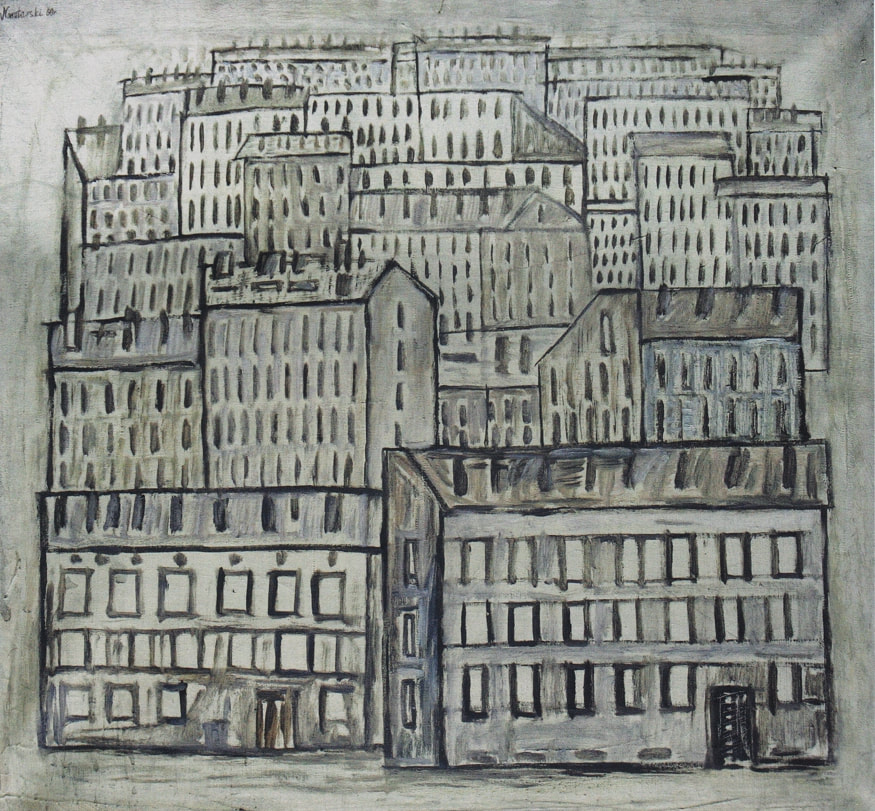
City, tempera on canvas, 80x75 cm, 1960
There is no point in describing paintings. It was you who said that after playing a concert or painting a picture its creator has nothing to say until the next work of art. What you wanted to paint, you did In the most excellent way. You are a master of creating moods ofreflection, thought, enchantment, admiration of the past, present and future. You paint time halted, noticed, presented and preserved forever. It is important what you paint and how. You avoid turmoil, accumulation of unnecessary elements in landscapes and still-life. You avoid a crowd, sometimes there is a man or a couple usually with their backs to the audience. A dog is an omniscient narrator, eager for feelings and compassion. Actors whose faces are turned towards the audience are portraits from the past, saved from oblivion.
"Somebody lived there, somebody lived there, Somebody lived there together with us.
Somebody lived there, somebody lived there They are no longer among us."
Life is a theatre, so you entered the theatre To better know the taste of life.
Pictures are a stage from which you removed unnecessary elements
for the viewer to release their imagination. "Blurred maps on the wallpapers
The world is emerging from the stains in the corner."
The texture of masterpieces which you have created absorbed and preserved the artist's real energy, which a sensitive admirer of your art can read and experience in the right way.
Roman Kalarus
"Somebody lived there, somebody lived there, Somebody lived there together with us.
Somebody lived there, somebody lived there They are no longer among us."
Life is a theatre, so you entered the theatre To better know the taste of life.
Pictures are a stage from which you removed unnecessary elements
for the viewer to release their imagination. "Blurred maps on the wallpapers
The world is emerging from the stains in the corner."
The texture of masterpieces which you have created absorbed and preserved the artist's real energy, which a sensitive admirer of your art can read and experience in the right way.
Roman Kalarus
|
|
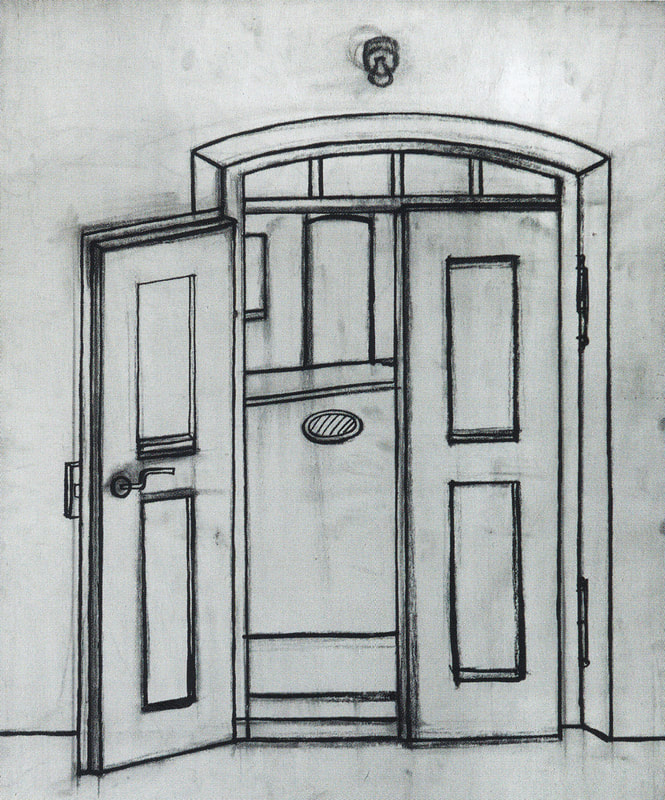
Sketch for a painting, 1970s
